


Introduction

India’s electric vehicle (EV) story is no longer a distant headline — it’s unfolding on city streets, in factory halls, and in state assembly chambers. Over the last few years EV sales have moved from a niche experiment to a rapidly expanding segment of the market. That growth is being actively encouraged by national and state policies, big private-sector investments, and affordable new models — and while those changes promise cleaner air and lower oil dependency, they also come with hard economic consequences: supplier firms, informal mechanics, fuel retailers and whole service chains that supported internal combustion engine (ICE) vehicles are feeling the squeeze. This post explains how the EV transition is happening in India, what government policies are driving it, which industries are at risk, and what projections say about the future — balancing the upside for emissions and energy security with the social and employment disruption that follows technological change.
How fast is the transition?
EV adoption in India has accelerated from almost zero a decade ago to a sizable presence across two-wheelers, three-wheelers, buses and an increasingly visible passenger-car segment. Government and industry reports show exponential growth in recent years — for example, one government-compiled overview reported EV sales rising from tens of thousands in the mid-2010s to well over two million cumulative sales by 2024. India has set ambitious targets (discussed below) to further raise EV shares in vehicle sales over the next decade. NITI AAYOG
Two trends matter especially: (1) EVs have become dominant in the high-volume, lower-speed e-two-wheeler market (scooters/mopeds) where companies like Ola, TVS, Bajaj and Ather account for the lion’s share, and (2) passenger-car electrification is rising fast as models from Tata, MG, Hyundai, and new entrants target urban buyers. Market reports show large year-on-year increases in e-two-wheeler production and a growing, though still limited, share of light-vehicle sales. EVreporter+1
Government policy: incentives, mandates and industrial push
India’s EV expansion is not purely market-driven — it’s a policy project. The Union government and several state governments have rolled out a patchwork of incentives, subsidies and manufacturing support programs to jump-start demand and local production:
- FAME and direct purchase incentives: The FAME (Faster Adoption and Manufacturing of Hybrid and Electric Vehicles) program — particularly Phase II — provided demand incentives targeted at buses, two- and three-wheelers and passenger vehicles, subsidizing purchase prices and helping early adopters overcome sticker shock. FAME II had a multi-thousand crore rupee budget and explicitly aimed to create demand through purchase support. Heavy Industries+1
- State EV policies and local concessions: Several states (Delhi, Karnataka, Maharashtra, Gujarat, Tamil Nadu, etc.) offer additional subsidies, registration tax waivers, lower electricity tariffs for charging, and land/plug incentives to attract manufacturers and battery plants. Some state moves are pro-active — e.g., Maharashtra repealing an intended EV tax to avoid discouraging buyers — while others are tailoring subsidies to two-wheelers and last-mile commercial vehicles where adoption directly benefits urban air quality and delivery fleets. Reuters+1
- Supply-chain industrial policy: Central programs (production-linked incentives, cluster development) and state packages attract battery makers, cell manufacturers, and OEMs to build local capacity. The goal is to reduce import dependence for cells and battery packs and to capture higher value chains in manufacturing. International players and large domestic OEMs have announced investments and factory expansions in response. BloombergNEF+1
- Regulatory nudges and fleet electrification: Public transport electrification mandates for buses and support to fleets (ride-hailing, delivery services) encourage bulk uptake. City procurements and commitments by ride-hailing platforms reduce risk for EV startups and create demand corridors.
Taken together, these interventions lower purchase costs, create predictable demand (especially for commercial vehicles), and attract capital to local manufacturing. That policy push is deliberate: India has stated goals to materially raise EV penetration by 2030 as part of energy security, emissions and industrial strategy. NITI AAYOG
Who wins — and who loses?
Every technological transition creates winners and losers; the EV transition in India is no different. Below are the major winners and the major losers so far.
Winners
- EV OEMs and battery suppliers enjoying strong growth and investment.
- New manufacturing hubs and component makers building battery and e-powertrain capability.
- Urban commuters and fleet operators who save on running costs (lower per-km energy costs and fewer moving parts to maintain).
- Energy and grid sectors that can monetize new electricity demand and charging services.
Losers / Vulnerable sectors
- Engine and powertrain component suppliers: EV powertrains are mechanically simpler. Several analyses show EVs require far fewer parts in the drivetrain than ICE vehicles — meaning fewer components to manufacture and fewer suppliers needed. One detailed manufacturing analysis quantified this: EVs may require roughly a seventh of the number of components in traditional ICE drivetrains, which is a profound structural shock to component makers. WRI India
- Aftermarket mechanics and informal service providers: ICE vehicles require regular oil changes, clutch and gearbox work, and engine tune-ups — services that sustain millions of small workshops. EVs have fewer service needs, and battery and electronics maintenance often requires specialized technicians and authorized service centers. As EVs replace ICE vehicles, informal mechanics face shrinking demand and income insecurity.
- Fuel retail and petroleum logistics: Retail petrol pumps, fuel distribution middlemen and associated transport services face long-term demand erosion. The pace depends on EV penetration in passenger and commercial fleets, but projections showing rapid uptake can translate into sizable declines in gasoline and diesel retail volumes.
- Component fabrication and heat-intensive suppliers: Suppliers that produced engine blocks, exhaust systems, fuel systems, and transmission components may see order books dry up unless they diversify into EV components (battery assembly, electric motors, power electronics).
- Used-vehicle and remanufacturing players tied to ICE: Parts remanufacturing and secondary markets for ICE components will likely contract.
Some studies and industry voices estimate material labour impacts: assembly lines for EVs typically require fewer workers than ICE assembly due to simpler drivetrains and fewer parts. Estimates vary — but a commonly cited range is that EV assembly and powertrain manufacturing could need 20–40% fewer workers on certain lines, depending on automation and localisation levels. That doesn’t necessarily translate into net job losses economy-wide (there’s potential for new jobs in batteries, software, and charging infrastructure), but the transition will be disruptive for the millions currently employed in ICE parts manufacturing and informal automotive services. Outlook Business+1
Evidence of closures, layoffs and firm stress
There are increasing reports of stress among suppliers and small businesses in the vehicle ecosystem:
- Several ICE-component manufacturers have seen order cuts as OEMs shift sourcing to power-electronics and fewer mechanical parts. Smaller vendors — which often lack the capital to retool quickly — are vulnerable to closure or consolidation. Think tanks and industry analysts have documented potential declines in employment intensity for a rapid EV-adoption scenario. WRI India+1
- Informal mechanics, roadside service shops and oil-change businesses in many towns are reporting lower volumes where EV adoption is concentrated. This is an anecdotal trend reflected in multiple local news and industry surveys, and it’s especially acute in clusters dominated by two-wheelers and three-wheelers — the very segments that have seen the fastest EV penetration.
- Fuel stations in some high-EV corridors are experimenting with conversion to charging hubs or offering convenience-store services to offset lost fuel sales — but conversion is capital-intensive and requires grid upgrades and regulatory clarity.
It’s important to note that the scale and distribution of closures depend on the speed of adoption, availability of alternative employment pathways, and how effectively policy supports reskilling and supplier diversification. The disruption will be concentrated in certain geographies and supplier niches, not uniform across the country.
Reduced fossil-fuel demand — how big a drop?
Electrification of transport reduces the need for gasoline and diesel — but the magnitude depends on uptake rates, vehicle mix and how electricity is generated. Global and national outlooks (IEA, BNEF, country models) show that electrification can significantly lower oil demand in transport over the next two decades. In India’s context, modeling exercises indicate substantial reductions in oil consumption if EV targets are met — with the largest near-term impact in urban two-wheeler and three-wheeler fuel demand and later effects in passenger cars and buses. BloombergNEF+1
Two caveats:
- Electricity source matters: Emissions benefits and fossil-fuel dependence reduction are bigger if electricity generation decarbonizes; if charging depends on coal-heavy grids, CO₂ gains are muted even as oil imports drop. India’s parallel push on renewables is therefore crucial to both emissions and energy-security outcomes. BloombergNEF
- Timing is uneven: Light vehicles and commercial fleets convert at different speeds. Two-wheelers and urban fleets (delivery, cabs) often electrify faster because of predictable routes and centralized charging — so localized gasoline demand falls first; diesel demand tied to heavy trucks and long-haul logistics declines slower.

The future outlook — projections and scenarios
Independent forecasters and institutional reports outline plausible paths:
- Moderate adoption scenario: If India reaches a 30% EV share of new vehicle sales by 2030 (an ambition stated in several government documents and industry plans), oil demand from road transport would flatten or decline, grid demand will rise (requiring investments in generation and distribution), and the auto supply chain will need to restructure dramatically. NITI AAYOG+1
- Fast adoption scenario: BloombergNEF and IEA scenario modeling (and national plans linked to aggressive policy incentives and strong local battery supply) show a faster decline in liquid fuel demand and higher demand for critical battery materials (lithium, nickel, cobalt, graphite). This increases import needs for battery materials unless domestic cell production scales up quickly. BloombergNEF+1
- Employment and industry structure: Academic and think-tank studies suggest that while direct jobs in ICE manufacturing may shrink, opportunities will emerge in battery manufacturing, recycling, power electronics, charging network deployment and software/telematics. But these new jobs may require different skills and are likely to be more capital-intensive, meaning fewer jobs per rupee of output compared with ICE supply chains unless targeted policies boost labour-intensive segments and supplier retooling. CEEW+1
Policy levers to reduce harm — what governments can do
The transition need not leave the most vulnerable behind. Policy options to soften the social cost include:
- Reskilling and targeted training: Large programs to retrain component workers and mechanics for battery assembly, electric motor winding, power-electronics repair and charging-station installation.
- Supplier transition support: Time-bound grants or low-interest loans to help small and medium suppliers retool from ICE parts to EV components, or to diversify into adjacent products.
- Inclusive procurement: Government fleet electrification contracts could include clauses favoring suppliers who retrain staff locally or subcontract to community enterprises.
- Charging jobs and MSME opportunities: Encourage small businesses to convert fuel stations into charging hubs, micro-grid operators, and convenience services — unlocking new revenue models for petrol-pump owners and shopkeepers.
- Social safety nets and phased transitions: Financial support, redeployment assistance and localized industrial policy for districts heavily dependent on ICE supplier clusters.
Countries that have faced similar structural shifts combined demand push with purposeful social and industrial policy; India’s response will determine whether the EV revolution is broadly beneficial or leaves concentrated pockets of hardship.
Conclusion — balancing climate, energy and livelihoods
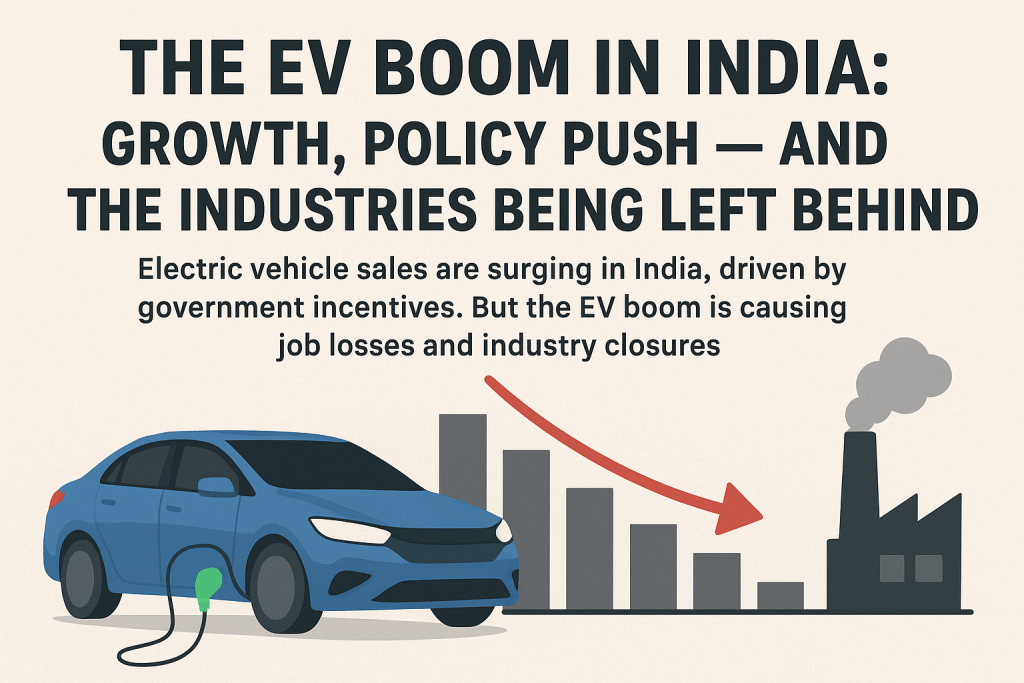
India’s EV boom is delivering cleaner urban air, reduced oil dependency and a chance to capture a global manufacturing opportunity. It’s also triggering economic pain in supplier networks, informal service sectors and fuel retail — the parts of the economy that are less visible but employ millions. The policy choices made today — not just to accelerate EV adoption, but to support supplier transition, reskilling, and equitable industrial development — will decide whether the EV transition is a net social gain or a sharp disruption for vulnerable workers and towns.
If India follows a well-managed path, the country can realize the emissions, energy security and industrial benefits of electrified transport while cushioning those most exposed. If the transition is left solely to market forces and incentives with little attention to people and small firms, we should expect a wave of closures and job stress in the coming decade.