




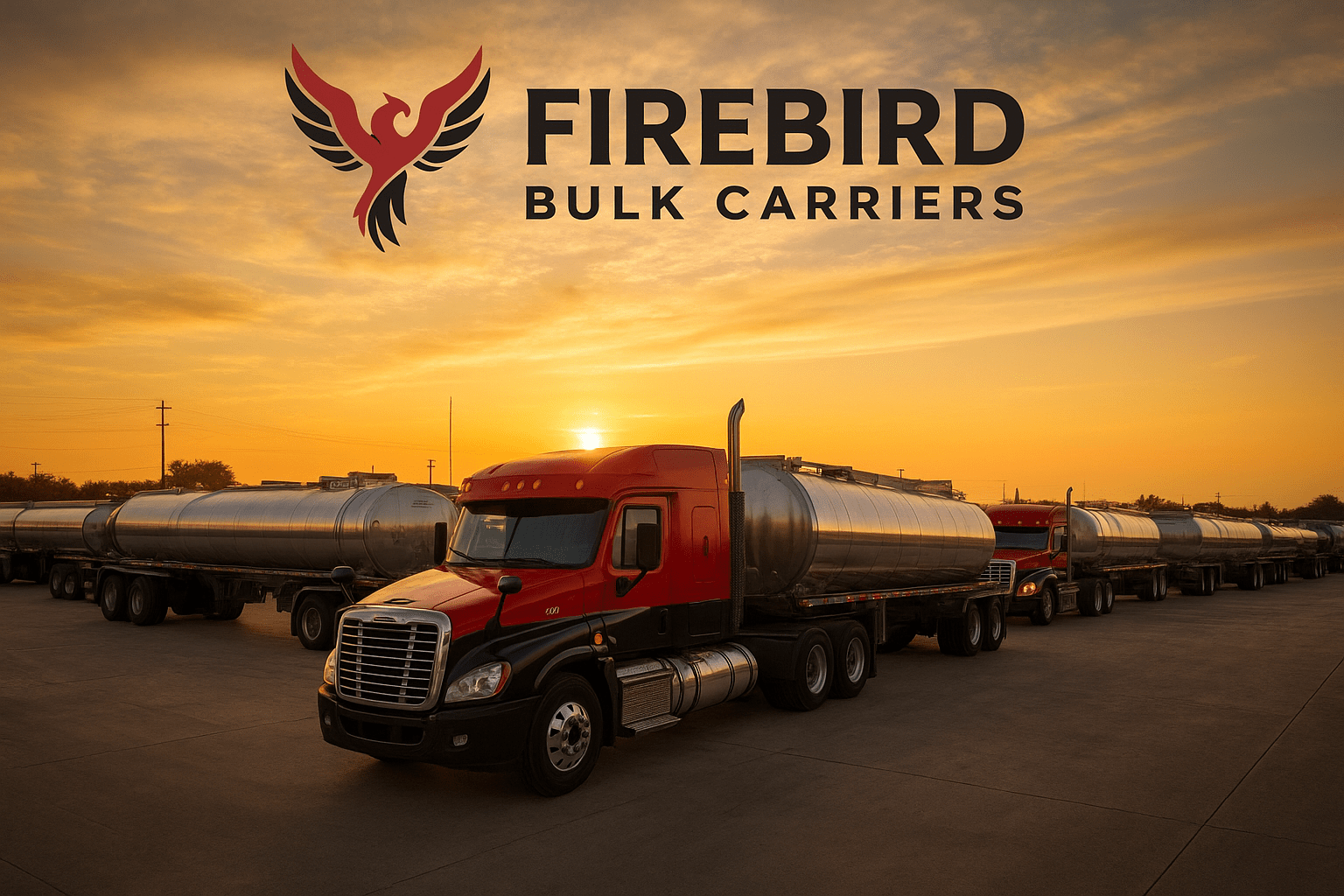
Firebird Bulk Carriers, a prominent crude-oil hauling trucking company headquartered in Dayton, Texas, is facing a major shakeup — the company has announced 74 permanent layoffs across multiple locations in the state. This news has sent shockwaves through its workforce and within Texas’s broader logistics and energy sectors, especially at a time when the trucking industry is already under intense financial pressure.

In this post, we’ll explore who Firebird Bulk Carriers is, what’s driving these job cuts, how the layoffs are unfolding across different Texan sites, and what the broader implications may be — both for the company and the trucking sector more broadly.
Who Is Firebird Bulk Carriers?
To understand the gravity of this development, it helps first to know what Firebird Bulk Carriers does.
Firebird Bulk Carriers is a specialized trucking company primarily focused on crude oil transport. Based in Dayton, Texas, the company operates a modern fleet that features Peterbilt and Mack trucks, equipped with advanced safety systems, GPS tracking, and hydraulic wet kits, among other features.Firebird Bulk Carriers Their trailers range from vacuum and stainless-steel tankers to aluminum crude oil trailers, end-dump trailers, and frac tanks.Firebird Bulk Carriers
They emphasize safety, reliability, and transparency, offering real-time reporting and monthly safety reports to their clients.Firebird Bulk Carriers The company has over 20 years of experience in the crude oil hauling business, making it a key link in the energy supply chain in Texas and beyond.
Firebird is part of a larger corporate structure: it was acquired (alongside Phoenix Oil, Inc.) by Adams Resources & Energy, a company with interests in fuel logistics, transportation, and energy services.Cloudfront This relationship may matter in how the company handles its current workforce reduction.
What’s Going On: The Layoff Announcement
In late 2025, Firebird Bulk Carriers filed a WARN (Worker Adjustment and Retraining Notification) notice with the Texas Workforce Commission, formally announcing that 74 employees would be laid off permanently by the end of December.CDLLife+2Chron+2
According to multiple sources:
- The layoffs are happening between December 1 and December 30, 2025.CDLLife+1
- While they span seven facilities across Texas — including Carrizo Springs, Victoria, Bryan, Dayton, Dilley, George West, and Tarzan — the Carrizo Springs location will be hardest hit, with 31 employees set to be laid off there.WARNTracker
- In George West, another WARN notice reported 21 job cuts.WARNTracker
- At Bryan, about 10 workers are being cut.WARNTracker
- Dilley will lose 6 employees.WARNTracker
- In Victoria, the WARN notice lists 3 layoffs.WARNTracker
- Even a more remote or smaller site — Tarzan — is impacted, with 1 employee laid off.WARNTracker
Notably, most of the job cuts are in driver positions (59 of the 74), but mechanics (6), supervisors, administrative support, and other roles are also being eliminated.San Antonio Express-News+2CDLLife+2
Why Is Firebird Doing This? Root Causes Behind the Layoffs
According to Firebird’s WARN filing and public reports, the company points to “unforeseeable business circumstances” driving the cuts.San Antonio Express-News The key factors:
- Loss of Contracts
Firebird claims it has lost about one-third of its contracts, a significant hit for a business heavily reliant on volume and long-term shipping commitments.CDLLife+1 Losing this much contracted business undermines their ability to maintain capacity and justify their operating expenses. - Rising Insurance Costs
Firebird is also grappling with higher insurance premiums, which it cites as another reason for its financial strain.San Antonio Express-News In the trucking business — particularly in hazardous sectors like crude oil transport — insurance is a massive cost center. When premiums spike, margins can get squeezed quickly. - Energy Market Pressures
Though not always explicitly stated by Firebird, the broader context suggests that volatility in the energy market, shrinking demand in certain regions, and tightening logistics economics are indirectly contributing. As other analysts note, the transportation, energy, and logistics sectors in Texas are already under pressure from fluctuating oil prices, continuing supply chain disruptions, and rising operational costs.Chron
The Human and Operational Impact
On Employees
The human cost here is real: dozens of drivers — many of them likely long-haul or route-focused — will be out of work by the end of December. Some mechanics, supervisors, and administrative staff are also being laid off, meaning this isn’t just a frontline reduction; it’s touching multiple levels of operations.
While the WARN notice is a formal requirement, it does not guarantee that affected employees will be rehired or find equivalent jobs elsewhere. There is, however, a small silver lining: Firebird has stated that some employees may be eligible to transfer to its parent company, Adams Resources & Energy, or its subsidiary, GulfMark Energy.CDLLife+1 But such transitions are rarely seamless, and many laid-off workers may face significant uncertainty.
On Operations
Shrinking the workforce by 74 people across key locations can have profound operational consequences. For a trucking firm, fewer drivers means less capacity to take on or maintain routes. It may mean fewer trucks rolling, longer lead times, reduced flexibility for clients, and possible reputational risk for reliability.
Furthermore, this downsizing may also compromise Firebird’s ability to scale back up quickly if market conditions recover. Once trained, experienced drivers are not easily replaced — recruiting and onboarding take time, and in a tight labor market, rehiring may not be quick.
Why This Matters for the Broader Industry
The Firebird Bulk Carriers layoffs do not happen in a vacuum. They reflect several systemic pressures in the energy-transport sector:
- Insurance and Risk Are Going Up
The trucking business, particularly for hazardous materials like crude oil, is intrinsically risky. As insurers tighten conditions or raise rates, companies like Firebird may find previously manageable risk becoming cost-prohibitive. - Contract Volatility
Losing a third of its contracts suggests Firebird may have been overextended, reliant on a few large customers, or vulnerable to market swings. This is a cautionary tale about concentration risk in logistics. - Macro Demand Weakness
The energy sector continues to navigate uncertain demand, as global forces, regulatory pressures, and shifting energy sources weigh on traditional crude markets. This puts downstream logistics companies (like Firebird) on the front lines of exposure. - Labor Challenges
The layoffs highlight broader questions about driver recruiting, retention, and labor costs. As trucking companies tighten, many may find themselves short-staffed when freight picks back up — or unable to attract experienced drivers. - Ripple Effects in Local Economies
Multiple Texas towns are being directly affected: Carrizo Springs, George West, Bryan, Dilley, Victoria, Dayton, and Tarzan. These are not just job cuts in isolation; they can impact local economies, tax bases, and community stability.
What’s Next for Firebird — and Its Workforce
Given the magnitude of this layoff wave, several possible scenarios could play out:
- Some Employees Transfer: As mentioned, a portion of the workforce might move over to Adams Resources & Energy or GulfMark Energy. Whether that happens, and how many take that path, will determine how many people are permanently out for good.
- Lines May Be Cut Permanently: If Firebird lost a third of its contracts, it’s possible some of those routes are disappearing, not just being scaled back. That could mean permanently shuttered operations in certain regions.
- Restructuring or Strategic Pivot: Firebird may try to renegotiate contracts, focus on its most profitable lanes, or adjust its cost structure. Layoffs could be part of a larger restructuring, not just a short-term belt-tightening.
- Long-Term Risk to Reputation: If service quality suffers as a result of fewer drivers or lower morale, Firebird risks damaging its reputation among clients — something that could hinder future contract wins.
- Regulatory and Insurance Scrutiny: Depending on how the company manages risk post-layoffs, it may face pressure from insurers or regulators, especially if safety or compliance become concerns.
Lessons and Key Takeaways
From a broader perspective, Firebird’s current crisis suggests several lessons for logistics companies, energy operators, and even policymakers:
- Diversify Contract Base: Overreliance on a few large contracts can be dangerous. Companies that haul crude (or any commodity) should aim for diversification in customer base and geography.
- Manage Risk Proactively: Rising insurance premiums are not an unpredictable “black swan” — they can be anticipated. Proactive risk mitigation, safety investment, and good loss history can help control insurance exposure.
- Invest in Workforce Resilience: Layoffs may offer short-term relief, but losing experienced drivers can undercut future capacity. Investing in driver recruitment, retention, and training is critical.
- Scenario Planning: In industries vulnerable to demand swings, companies should regularly run scenario planning for worst-case demand drops. Layoffs should not be reactive but part of a structured risk response.
- Transparent Communication: Companies filing WARN notices should consider offering more clarity, support, and transition options. Clear communication with staff, communities, and stakeholders can reduce reputational fallout.
Human Impact: Stories Behind the Numbers
Numbers can tell part of the story — but behind each of those 74 positions being cut are real people, families, and communities. These layoffs likely affect:
- Drivers who may have spent years on the road, building relationships with dispatchers, clients, and fellow drivers.
- Mechanics, who keep the fleet rolling, maintaining complex vehicles under high safety standards.
- Administrative staff and supervisors, who support daily operations, logistics, compliance, and planning.
- Smaller Texas towns, where the loss of even a few dozen jobs can ripple through local economies.
Some of these workers may find new roles, especially if they transition to Adams Resources & Energy or GulfMark. But not everyone will — and many will face uncertainty during the holiday season as the layoffs take effect.
Conclusion: A Defining Moment for Firebird (and Texas Trucking)
The decision by Firebird Bulk Carriers to cut 74 jobs is more than just a cost-saving move — it’s a sign that the company is under serious stress. Losing a third of its contracts, facing soaring insurance costs, and trimming its workforce across multiple locations suggests that Firebird is rethinking its business in real-time.
For employees, this is a moment of hardship and uncertainty. For the company, it’s a critical inflection point: will it shrink and stabilize, or will this mark the beginning of a deeper contraction? And for the broader trucking and energy sectors, Firebird’s troubles serve as a reminder that even well-established players in high-stakes markets are vulnerable.
As this story unfolds, it will be important to watch not just how Firebird navigates the immediate fallout but whether it emerges more resilient — or whether these layoffs are the first of more to come.